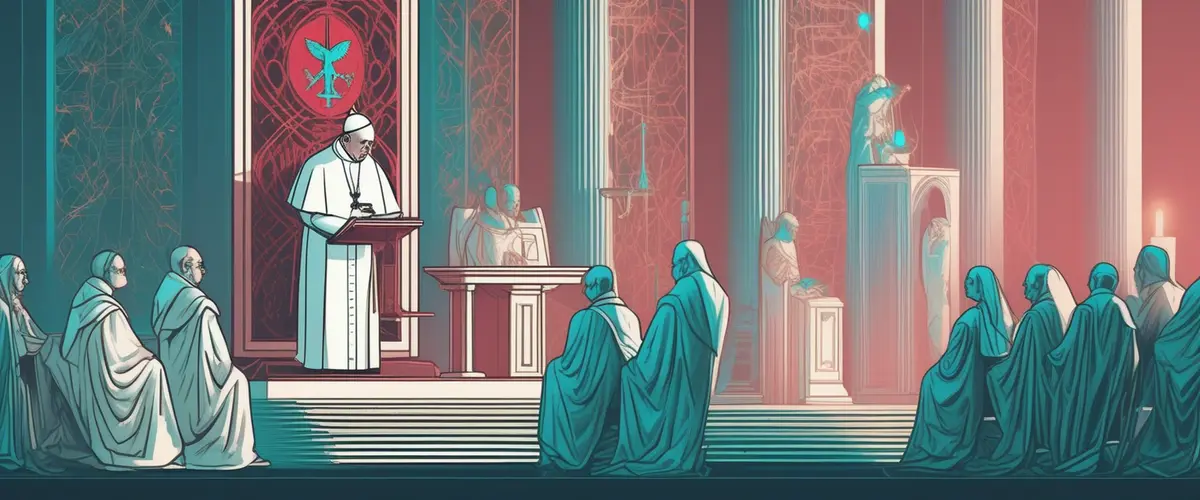
Yesterday, Pope Leo XIV published his first encyclical. Topic: artificial intelligence. Title: Magnifica Humanitas — "Magnificent Humanity." 42,000 words. And he didn't present it alone.
Standing next to him was Chris Olah, co-founder of Anthropic — the AI company behind Claude. Olah is not a believer. He was there anyway. That already says something.
Coal miners then, algorithms now
The encyclical was deliberately published on May 25 — exactly 135 years after Rerum Novarum, Leo XIII's landmark document from 1891 defending workers' rights during the Industrial Revolution. Back then: factory workers, child labor, exploitation by capital. Today: AI, data power, automation by algorithm. The Pope draws this parallel consciously. And it fits.
The Industrial Revolution took decades before labor laws, unions, and protective legislation reined in the worst abuses. Whether AI moves faster is a question Leo XIV leaves open. But it hangs in the air.
What Leo XIV actually writes
No technology-bashing, no apocalypse. The Pope distinguishes:
AI can be good. In medicine, research, and public administration, it can provide genuine benefit. He explicitly acknowledges this.
AI can be dangerous. Not because machines turn evil. But because people use it to concentrate power. Small, influential groups could control information flows, manipulate democratic processes, and tilt economic dynamics in their favor.
AI has no conscience. It processes data. It simulates certain human capabilities. But it has no consciousness, no moral judgment. Forgetting that means confusing a tool with a being.
AI must be "disarmed." Autonomous weapons systems that decide life and death without human judgment — Leo XIV rejects this clearly. No machine should wage war.
And then this line, which lands:
"A more ethical AI is worthless if that ethics is determined by a few."
That's not a religious statement. That's tech criticism, precisely put.
The elephant in the room
You don't have to be Catholic to agree with these points. Many of them read like the most clear-eyed AI analysis you can find right now — no theological packaging required.
But here's the actually interesting part: why was Anthropic's Chris Olah on that stage? He said it himself: the Church's voice — with over a billion followers worldwide — is needed to ensure that the gains from AI are shared globally. AI development is concentrated in a handful of wealthy nations. Who speaks for the rest?
Nobody in Silicon Valley does.
What this means for the rest of us
A papal encyclical is not a law. It's a statement. A very long, very seriously taken statement from an institution with 2,000 years of practice in long-term thinking.
For the rest of us, this means: the debate around AI power and AI control is no longer purely technical. It's social, political — and apparently also theological. When one of the largest global institutions formulates a 42,000-word response to it, the topic has arrived in the center of society.
Whether the Pope's demands will be implemented is another question. AI regulation is slow, grinding, and barely coordinated internationally. The EU AI Act is a start. Nothing more.
But a Pope and an Anthropic co-founder standing on the same stage delivering the same message — that's at least a sign that even within the AI industry, not everyone is satisfied with where things are headed.
Five years ago, that would have been unthinkable.